Modernization
Please note: spoilers up through the season finale of Starfleet Academy season 1 in this post.
This is a blog post about Starfleet Academy, though it's also very much not a blog post about it.
This is a blog post about how I'm not okay with a Trek character using the word "spooged." Honestly I don't think I'm okay with any character using the word "spooged" but it's particularly egregious in this instance.
This very much is a blog post about how Nus Braka, the "villain" (if there can be said to be one) of SFA's first season, absolutely fucking sucks on every creative level.
Starfleet Academy is the newly-released show about the eponymous school that is basically a high school (yes it's a college, don't tell the writers, also as a college professor, freshmen are basically still high school students) teen relationship drama with a Trek twist, set after the end of Discovery's third season and the Federation newly rebuilding and recovering from the Burn.
Really, though, this is about all the 'modern' trek: Discovery, Star Trek: Picard, Strange New Worlds, and Lower Decks too, in addition to Starfleet Academy. In fact, Lower Decks is particularly important since the voice (and body, once) of Beckett Mariner, Tawny Newsome, is also an accomplished writer as well as an actress, and is in the SFA writer's room.
I think we can all agree that fandom ruins everything, and often the reason they ruin everything is because they entered fandom through a particular set of formative experiences. The problem is, the longer a media property runs — and the more it becomes a cultural institution or brand, rather than a singular text or set of texts — the more, well... space there is for that property's fictional universe to expand.
The result is, inevitably, internecine struggle between groups of fans who are doing the discursive equivalent of slamming two action figures together to say that they're fighting. Which edition of Dungeons and Dragons is the "best" one? What Star Wars shows are "actually good"? Which Final Fantasy represents the "real" Final Fantasy? Repeat ad infinitum until we all die of boredom.
Star Trek fandom is no exception. Back when Deep Space Nine was on the air, fans were upset that Starfleet black ops baddies Section 31 had ruined the series and Trek, because it implied that the to-date morally perfect, upstanding, and optimistic Federation wasn't all that it appeared to be. If you've watched DS9, you know that this is an absurd claim; one of the series' consistent themes was about the limits of Starfleet's morality and approach through the entire Dominion War storyline (i.e. the back 40% of the show, easy), culminating in the now-famous season 6 episode "In the Pale Moonlight".
Now, I don't think Section 31 ruined the fiction of the Trek universe, and people who got in a serious lather about it needed to touch grass. They did sort of have a point, though: the to-that-point history of Trek was TOS and TNG, which were both to varying degrees utopian in outlook about the future, and a secret black ops assassination and espionage office does kinda feel a little... anti-utopian. That part's not in question.
But now we're in The Last Jedi territory, a film of equally divisive narrative choices in a long-running franchise with an equally, if not more, fractious and grognard-y fandom. Does TLJ make choices — "it's time for the Jedi to end," Rey being Just Some Person rather than from an Important Family, an anti-war profiteering segment in a fancy casino, many others — that feel a little discordant with Star Wars up to that point? It sure does. That's not in question either.
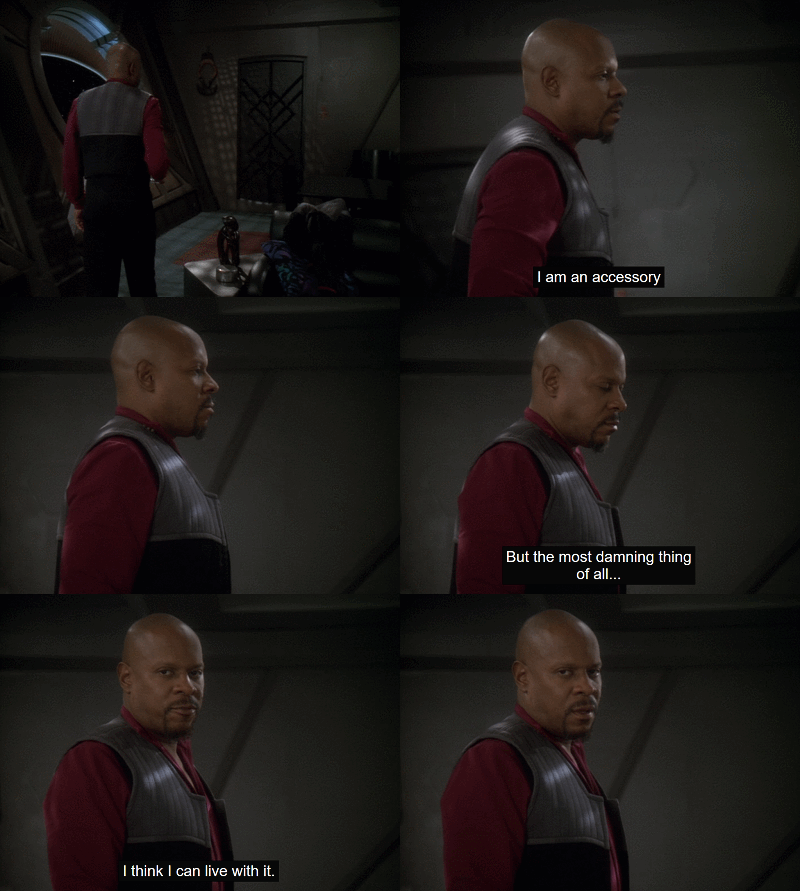
The actual question is: did it make for stronger, more impactful moments? For me, personally, in both TLJ1 and DS9's case, I think the answer is "yes." The moment above, where Sisko addresses the audience directly to deliver the "I think I can live with it" line, haunts me a little still.
What the hell does this have to do with modern Trek? This is where Lower Decks comes in. When that show came out, I admit to not being interested and avoiding it; a "sitcom" Trek about Millennial-analogs that felt like an extended deliberate riff on The TNG ep of the same name (one of the more tragic eps of that show, even!)? The animation gave me Family Guy vibes and my feelings about that show were notoriously negative. I noped out.
I think past me can be forgiven for wariness, but when I actually relented and watched the show (around the start of its 4th season) from the beginning, I was rewarded with a very funny show that, while comedic, was clearly in love with Star Trek. It wasn't a requirement that you be a Trekkie to get all the humor on Lower Decks, but it definitely added nuance to a lot of them. Every episode brought in some little touch or nod to the wider Trek universe that felt like, in a very real way, the series looking at itself and going "okay some of this stuff was dumb as hell, right?"
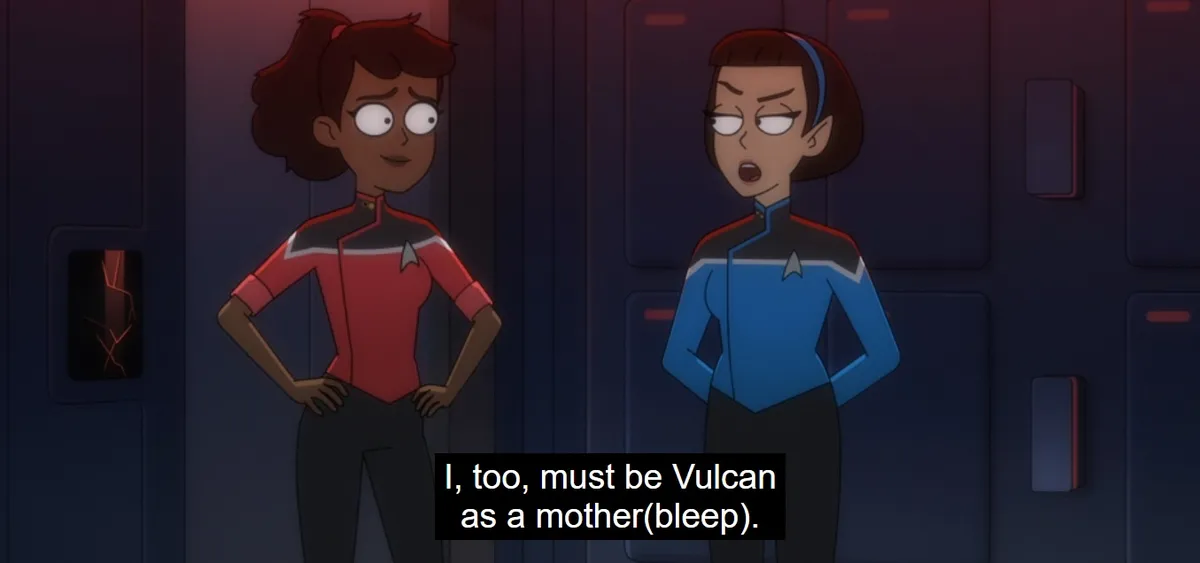
One of the ways it did that, though, was... well, modernizing the language and the way people speak. Looking at the lens of what was, at that point, 20+ year old material from the vantage point of now. The above shot is from season 4, ep 5, "Empathological Fallacies"2. T'Lyn, hearing that Sarek had Bendii Syndrome, observed that "By the transitive property, I too must be Vulcan as a motherfucker." I'm sorry, but traditional laconic Vulcan delivery saying "motherfucker" is funny. It's really funny.
The level of curse words being thrown in the "modern" Treks I listed above is hefty compared to their predecessors, which aired in a very different broadcast regulation and cultural acceptance climate than now. It was, not to abuse the saying, a different era3. So on the one hand, saying "shit" and fuck" both didn't jive with the vision of the future Roddenberry was probably originally imagining, but even if it had, it would have been verboten anyway.
Part of the very genuine challenge, with writing speculative fiction (sci-fi, fantasy, etc.) is that you are writing about a different time/place/world/etc. — a different context, sometimes a radically different one — but it is a human, now, creating it for other humans, now, and as time marches on, the context of those "now"s changes. You have to create something that is different enough to be interesting or engaging, but "modern" enough so that a reader can actually comprehend it.
It is a fine line to walk, and frankly I don't envy any creators who do. I think about how someone was once annoyed that Han Solo, in The Empire Strikes Back, says "then I'll see you in Hell," because why would the SW universe have a word for 'Hell' and [throws hands in air]. I'm just as guilty of this as anyone, sometimes; I think "Darmok" is one of the niftiest episodes of TNG but I'm also aware that if you poke it even a little bit, logically, it all falls apart on a conceptual level. Still, we're back at the Section 31 question: that episode ran on vibes, and the vibes were sublime. It is not necessary for science fiction to be exacting in its sociolinguistics to be engaging viewing.
Going all the way back to the first seasons of Discovery airing, the "modern language" — including but not limited to cursing — was a sticking point with some fans, who felt it (surprise!) harmed the idea of what Trek is. See also a story from October of last year where Rick Berman and Brannon Braga complained about this very thing.
Frankly, it never bothered me. Maybe it's because I'm a Final Fantasy fan, which has given me a lot of practice at saying "things are going in a different direction than what I loved, so it might not be for me anymore," but that was really where I landed. It was a newer show by younger writers aimed at a slightly different audience. If bits of it didn't work for me, well... that's about me, not the show. Adulthood has made me thoroughly uninterested in the sort of fandom arguments I described at the start of this post, and this would be just another one of them.
Two things finally swung me around on this: Nus Braka, and Stephen Colbert.
Let me say upfront: I've been watching Starfleet Academy, but I don't think it's a very strong show right now. I'm invested enough to keep up, but I really hope between now and the start of a season 2 (if there is one) that they find some focus and direction. The show's primary weakness right now is that it's trying to be an early 00s era CW teen drama AND an action-y modern Trek show AND a comedy, all at the same time, but the end result means watching the show feels a bit like that style of execution where they tie your limbs to different horses and send them off in different directions: you're torn on the experience (literally).
Considering I blogged about this show not that long ago, however, I clearly still think it's worthwhile on some level.
If you hate "modern language" in your Trek, you will despise SFA. The level of swearing, 20th-21st century linguistic references, and other such flourishes is considerably higher than Discovery or SNW and fully on par with Lower Decks. Layered on top of this is the show's targeting a much younger audience; I'm not as confident as others that it's aimed at "teens," but it certainly does seem to be looking for watchers in their 20s-ish. So if you, like me, are in your late 40s, grew up on TOS and TNG, and spend a lot of your day wondering what the difference between "sauce" and "juice" is because you are now An Old, the dialogue writing on SFA may not be for you.
However, for the most part I was willing to put up with it. I didn't like it, but I put up with it.
But.
A running gag over the whole season of the show is that the "Virtual Dean of Students," an AI voiced by Stephen Colbert, routinely announces in bigger scenes taking place in the Academy at large, jokey voice overs. With all respect to Colbert, who is perfect casting for the role they appear to have imagined... I hate them. I hate all of them. I hate Specialist Krebs and their fucking furfly, I hate hearing Stephen Colbert literally say "keep it in your pants" on a Star Trek show. I genuinely think it is awful.
If it had just been the "Virtual Dean," I'd probably have gotten over it, but SFA insists that part of its crisis of identity be that it can't decide if it's Degrassi or a sci-fi action show, so there is an overarching, cosmic-level, "the galaxy is in danger" plot featuring a new faction called the Venari Ral, who are represented by pirate/criminal/jackass Nus Braka, played with maximum smarm by Paul Giamotti.
Braka, as we find out in the season finale "Rubincon" (not a typo), is a survivor from a small, starving colony he believes was blown up by the Federation, but which was instead quite literally ignited by his space redneck4 father attempting to shoot a Federation relief transport out of the sky.
He is a man-child in every sense of the word, and even if it weren't glaringly obvious from his behavior, the show literally puts those words in the mouth of Holly Hunter's Chancellor Nahla Ake, one of the show's main characters.
Part of how this is established are his speech patterns; he makes constant jokes, many of them overtly sexual. Here's a little sampling of how he talks taken from an episode where he features heavily, "Come, Let's Away":
- Calling Nahla his "space boo" and "interstellar bestie"
- "I'm wanked, spanked, and ready to be a diplomat"
- "that is a slippery cat-piss aftertaste"
- "they're in ball-clenching, sphincter-puckering pain all the time; the only relief they get is to just spooge it all over other people"
Y'all, those lines are just from the first FIVE MINUTES he is on screen in this episode. While I try not to be judgmental on this level in my writing: this dialogue fucking sucks. Like, they're trying to do some extremely discount Joker thing with him, where he's secretly some sort of tactical genius — the stinger in the plot of "Come, Let's Away" is that the entire situation is a setup by him to break into a Federation weapon development starbase — but mentally and emotionally is just so WACKY and INAPPROPRITE because he is, and I do not say this lightly, White Space Trash. There's a joke about "Nus" being short for "Nustopher" at one point, for crying out loud.
There is a strong classism element to Braka and the core of his beef with the Federation, which is that he sees them as imperious colonial overlords who look down on the poor, and he is (in his own eyes) the righteous liberator that's going to bring "true freedom" to the galaxy, which... interesting angle to judge the Federation on, and not undeserved, but utterly shot in the foot by what a clown Braka is (and how his story is, you know, based on a lie).
Which: fine. His dialogue, though... and not just his dialogue, but his body language, mannerisms, tone of voice, etc., are all hyper-exaggerated and... well, smarmy. He's the sort of character the libretto for a musical might call "oily." It's a bit like someone tried to create a Harry Mudd-style villain, but learned all the wrong lessons, and it's not like nu-Trek hasn't tried this before! SNW did multiple episodes featuring literally Harry Mudd and managed to do a pretty good job at making him the right blend of "low-class" and "Star Trek."
In that article I linked earlier, Berman and Braga both talk about how the modern language thing just "isn't Trek;" how there's a way to approach or use language on Star Trek where modern jokes and curse words and whatever simply don't fit. They may be right, on some level, but I think its world has to grow as people do. Part of the joy of Lower Decks, or characters like Tilly on Discovery, is that they react and talk like we do; they're a reminder that maybe there are people just like us in the future, too. People who say "fuck!" and get exhausted at the idea of going to work and sometimes say inappropriate things to their boss at work5.
When it comes to Braka and the Virtual Dean, though... I think it goes too far, and I think SFA wanting to be everything at once — a comedy, a serious sci-fi show, a teen drama — contributes. The difference between a Henry Mudd and a Nus Braka, between repeated Urusei Yatsura refs in the background and "your Talaxian furfly is mating with itself," is perhaps thin, but it's extant. When I apply the "does this diversion from tradition feel like it improves the content" test to those things, I come up with a heavy, serifed "NO."
It's a shame that I don't like SFA more, because I feel like it has done some incredible things; Tawny Newsome's work writing on the episode "Series Acclimation Mil" really made me turn the corner on SAM, a character who to that point I had really disliked. In interviews, Newsome talked about how much care they had to take to respect and honor the ending of DS9, and I was reminded that part of what I love about Lower Decks is, again, that feeling that these jokes are coming not at Trek's expense, but from love of Trek.
I don't get the impression that Nus Braka's dialogue comes from love of anything, other than C-grade comedy trying to "feel relevant." There's nobody (not even you, Braga and Berman) who is the arbiter of what is or isn't Trek, but if I have to weigh in when it comes to some of Starfleet Academy's major character dialogue touches? That ain't it, chief.
I once had a conversation in an online space where I talked about how emotionally cool the "Holdo Maneuver" scene was, and someone confidently and angrily told me that it was why TLJ is the worst movie, because if you could actually do that, the entirety of space naval warfare would have to change, and proceeded to bring in a huge list of things from various licensed Star Wars novels, etc., and I'm not sure what his final point was because I'm pretty certain I started dissociating.↩
The other thing about this ep I love is that Betazed has a secret service but it's also leopard print-wearing cougar wine moms in their 50s. Imagine an entire Section 31 staffed by minor variations on Lwaxana Troi. Jesus christ.↩
One of my favorite one-off jokes from the season 2 SNW episode "Those Old Scientists" is a time-traveling Beckett Mariner reflecting on how weird the past is: "Have you noticed how slow everybody talks?"↩
Have you noticed that's another nu-Trek thing? Like, in Star Wars, planets have two settings: glittering metropolis or Rural Space Kentucky, and increasingly, modern Treks are doing that to non-Federation planets. Tightly-packed, note-quotes "filthy and poor," almost always represented by an open-air market of some kind. Suddenly half the galaxy is Mos Eisley. So weird!↩
Cue Anthony Rapp saying, with a faint smile, "No, Ensign. It is freakin' cool."↩